Diffraction in Quantum Systems
Martin Sieber
Semiclassical treatment of diffraction
|
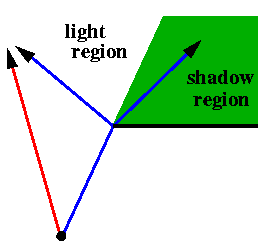
Semiclassical approximations in quantum mechanics are the analog of geometrical optics approximations for electromagnetic waves. Consider, for example, a light source and a metallic plate (black) as shown in Fig. 1. In geometrical optics the intensity and phase of light at an observation point are given in terms of a ray from the source to the observation point (red). The observation region is divided into an illuminated region and a shadow region which is inaccessible to direct rays. In order to describe the diffraction of light on the edge of the plate geometrical optics has to be extended. This is done by introducing an additional kind of rays (blue) that go to the observation point via the edge of the plate. The underlying theory is Keller's geometrical theory of diffraction. |
Fig. 1 |
Similar methods are applied for describing
diffraction in quantum systems in the limit
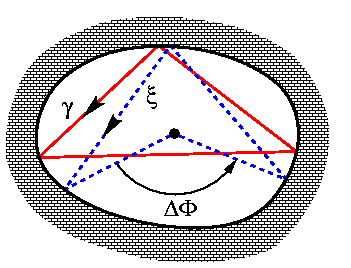
of small wave lengths. Fig. 2 shows a system
that is confined to a finite region which
contains a magnetic flux line. In the general
semiclassical theory the energy spectrum of
the quantum system is approximated in terms
of periodic orbits (red). The diffraction
of wave functions on the flux line requires
the introduction of an additional set of
trajectories that start from the flux line
and return to it (blue).
|
|
Fig. 2 |
Diffraction and spectral statistics
One way of characterising a complex quantum system is
to consider statistical distributions of its high
lying eigen energies. It has been found that these
distributions reflect the nature of the underlying
classical system. In particular, if the classical
system is chaotic its spectral statistics coincide
with those of eigenvalues of random matrices.
This agreement has been observed in numerous
numerical investigations. Semiclassical methods can
be used to explain this agreement in certain regimes.
In one project we investigated whether diffraction
on singularities
of the potential can lead to modifications of these
results. In particular, we examined whether the
addition of a point scatterer to a system can
change its spectral statistics.
It was shown for the first terms in a semiclassical expansion
that there is no change in the spectral statistics if the classical
system is chaotic.
- M. Sieber, Spectral Statistics in Chaotic Systems with a Point Interaction, J. Phys. A 33 (2000) 6263-6278.
- M. Sieber, Geometrical Theory of Diffraction and Spectral Statistics, J. Phys. A 32 (1999) 7679-7689.