 #
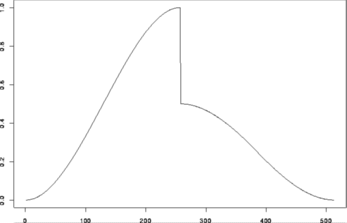
# Decompose test.data and plot the wavelet coefficients
#
> wds <- wd(test.data)
> plot(wds)
#
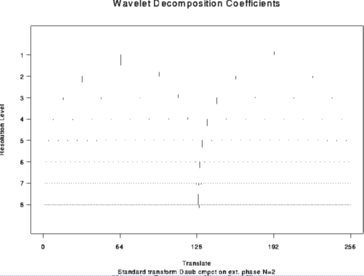
# Decompose test.data and plot the wavelet coefficients
#
> wds <- wd(test.data)
> plot(wds)
 #
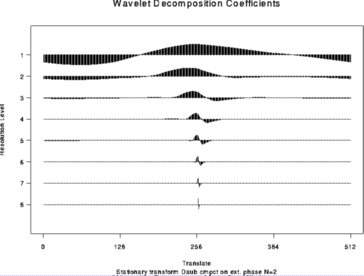
# Now do the stationary wavelet transform of the same thing
#
> wdS <- wd(test.data, type="station")
> plot(wdS)
#
# Now do the stationary wavelet transform of the same thing
#
> wdS <- wd(test.data, type="station")
> plot(wdS)
Then from this you obtain two vectors of length 2^(m-1). One of these is a set of smoothed data, c(m-1), say. This looks like a smoothed version of cm. The other is a vector, d(m-1), say. This corresponds to the detail removed in smoothing cm to c(m-1). More precisely, they are the coefficients of the wavelet expansion corresponding to the highest resolution wavelets in the expansion. Similarly, c(m-2) and d(m-2) are obtained from c(m-1), etc. until you reach c0 and d0.
All levels of smoothed data are stacked into a single vector for memory efficiency and ease of transport across the SPlus-C interface.
The smoothing is performed directly by convolution with the wavelet filter (filter.select(n)$H, essentially low- pass filtering), and then dyadic decimation (selecting every other datum, see Vaidyanathan (1990)). The detail extraction is performed by the mirror filter of H, which we call G and is a bandpass filter. G and H are also known quadrature mirror filters.
There are now two methods of handling "boundary problems". If you know that your function is periodic (on it's interval) then use the bc="periodic" option, if you think that the function is symmetric reflection about each boundary then use bc="symmetric". If you don't know then it is wise to experiment with both methods, in any case, if you don't have very much data don't infer too much about your decomposition! If you have loads of data then don't infer too much about the boundaries. It can be easier to interpret the wavelet coefficients from a bc="periodic" decomposition, so that is now the default. Numerical Recipes implements some of the wavelets code, in particular we have compared our code to "wt1" and "daub4" on page 595. We are pleased to announce that our code gives the same answers! The only difference that you might notice is that one of the coefficients, at the beginning or end of the decomposition, always appears in the "wrong" place. This is not so, when you assume periodic boundaries you can imagine the function defined on a circle and you can basically place the coefficient at the beginning or the end (because there is no beginning or end, as it were). (N.b. we have also checked our code against Donoho and Johnstone's TeachWave for Matlab, and again the answers are the same except that our wavelet coefficients are the negative of theirs).
The STATIONARY DWT is very similar to the standard DWT. The stationary DWT contains all circular shifts of the standard DWT. Naively imagine that you do the standard DWT on some data using the Haar wavelets. Coefficients 1 and 2 are added and difference, and also coefficients 3 and 4; 5 and 6 etc. If there is a discontinuity between 1 and 2 then you will pick it up within the transform. If it is between 2 and 3 you will loose it. So it would be nice to do the standard DWT using 2 and 3; 4 and 5 etc. In other words, pick up the data and rotate it by one position and you get another transform. You can do this in one transform that also does more shifts at lower resolution levels. There are a number of points to note about this transform.
It is translation invariant. The standard DWT is O(N) in computational effort the stationary is O(Nlog(N)) and produces Nlog(N) coefficients. The standard DWT is orthogonal, the stationary transform is most definitely not. This has the added disadvantage that stationary wavelet coefficients at all but the finest scale are correlated, even if you supply independet normal noise. This is unlike the standard DWT where the coefficients are independent (normal noise).
Coifman, R.R. and Donoho, D.L. (1995) Translation-Invariant De-Noising. To appear Wavelets and Statistics, Anestis Antoniadis, ed. Springer-Verlag Lecture Notes, 1995.
Daubechies, I. (1988) Orthonormal bases of compactly supported wavelets Communications on Pure and Applied Mathematics, Vol. 41, 909-996
CML TR95-03, Lang, M., Guo, H., Odegard, J.E., Burrus, C.S. and R. O. Wells, Jr., Nonlinear Processing of a Shift Invariant DWT for Noise Reduction, accepted for the Proceeding of SPIE, Mathematical Imaging: Wavelet Application for Dual Use, in SPIE Symposium on OE/Aerospace Sensing and Dual Use Photonics, 17-21 April 1995, Orlando, FL.
Mallat, S. G. (1989) A theory for multiresolution signal decomposition: the wavelet representation IEEE Transactions on Pattern Analysis and Machine Intelligence. Vol. 11, Number 7 674-693.
Nason, G. P. and Silverman, B. W. (1994). The discrete wavelet transform in S. Journal of Computational and Graphical Statistics, Vol. 3, 163-191.
Nason, G. P. and Silverman, B.W. (1995). The Stationary Wavelet Transform and some statistical applications. February 1995, Technical Report, Department of Mathematics, University of Bristol.
Shensa, M.J. (1992) The discrete wavelet transform - wedding the a trous and Mallat algorithms IEEE Transactions on Signal Processing. Vol. 40 Number 10 2464-2482.
Vaidyanathan, P. P. (1990) Multirate digital filters, filter banks, polyphase networks and applications: a tutorial. Proceedings of the IEEE, Vol. 78, Number 1, 56-93
# # Generate some test data # > test.data <- example.1()$y > tsplot(y)